
Food and chemical safety systems have become increasingly effective at detecting hazards and coordinating responses. However, there is an important distinction between responding to an identified problem and anticipating a problem that may be developing. Incident-response systems start from evidence that a specific risk or non-compliance already exists and help authorities act rapidly to contain it. On the other hand, anticipatory approaches start earlier: from signals, sometimes weak, fragmented or uncertain, that suggest a new hazard, exposure pattern or risk driver may require attention. The objective is not to predict the future with certainty, but to recognise relevant signals early enough to investigate them before a risk becomes established or widespread. In particular:
| Incident response | Risk anticipation |
| Starts from an identified problem or risk | Starts from signals that may indicate a developing problem |
| Confirm → communicate → contain | Collect → connect → assess → prioritise |
| Examples: alerts, withdrawals, recalls | Examples: horizon scanning, emerging-risk analysis, early-warning systems |
| Main question: What has happened and what should we do? | Main question: What may be developing and should we investigate it now? |
Europe is increasingly building this anticipatory capability on top of its established incident-response infrastructure. In food safety, the Rapid Alert System for Food and Feed (RASFF) enables authorities to exchange information rapidly once a food or feed risk has been identified; it therefore remains primarily an incident-response mechanism, even though rapid action can prevent harm. Further upstream, EFSA combines horizon scanning, emerging-risk analysis, expert networks and the Emerging Risk Analysis Platform (ERAP) to identify and assess signals. Its 2025 activities illustrate how selective this process must be: 55 topics were considered, 43 analysed in depth, 25 underwent further structured assessment and only four were ultimately identified as emerging risks.
| European initiative | Where it acts | Relevance to anticipation |
| RASFF | Identified food/feed risk | Rapid information exchange and coordinated response |
| EFSA emerging-risk & horizon-scanning activities | Signals, weak signals, drivers and emerging issues | Progressive filtering and scientific assessment of potential emerging risks |
| HOLiFOOD / FoodSafeR | Emerging food-safety hazards | EU research on early warning, data integration, AI and proactive risk analysis |
| PARC Early Warning System | Emerging chemical risks | Development of approaches combining monitoring, non-target screening, hazard information and computational methods |
| EU Early Warning and Action System for emerging chemical risks | Signals of potential chemical risks | Regulation (EU) 2025/2455 requires the EEA to establish the system by 2 January 2027, integrating signals from national systems, EFSA, scientific literature, human biomonitoring and other EU data sources. |
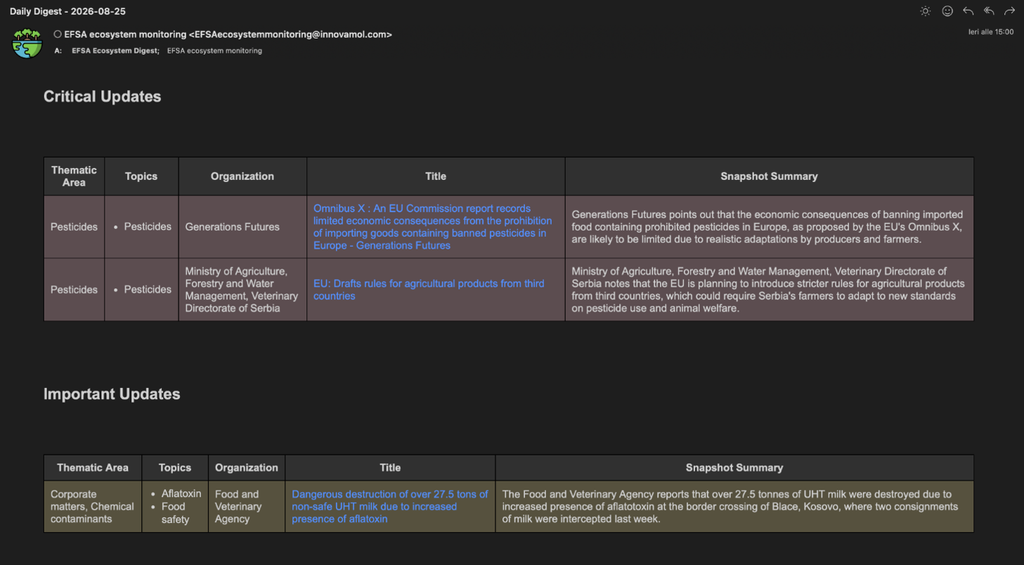
Innovamol is also contributing to this effort by developing tools and workflows that support the systematic collection, classification and prioritisation of signals from the scientific and regulatory ecosystem. For instance, in the figure below there is an example of an Innovamol Daily Digest covering EFSA’s regulatory remits. It should be noted that, a monitoring digest is not an early-warning system by itself: it represents an upstream signal-collection and triage layer from which potentially relevant developments can be identified, connected with other evidence and followed over time. However, time-series analysis of previously collected signals can help identify upward trends and recurring patterns that may precede the emergence of a new hazard, exposure pathway or regulatory concern.
The common element across these initiatives is therefore not simply the use of more data or more sophisticated algorithms. It is the ability to transform a continuous flow of heterogeneous information into signals that can be evaluated in context. Relevant indications may originate from scientific literature, regulatory developments, monitoring programmes, analytical measurements, environmental or climate observations, trade patterns, stakeholder information or other data streams. A single observation may mean very little; several independent signals pointing in the same direction may deserve investigation. The critical workflow is therefore:

This also defines the appropriate role of AI. Machine learning, text mining and natural-language processing can increase the amount of information that can be screened and help identify relationships that would otherwise be difficult to detect. But anticipation remains dependent on data quality, provenance, interoperability, transparent prioritisation criteria and scientific judgement. A signal is not evidence of a risk, and an algorithmic flag is not a regulatory conclusion. The real value comes from creating traceable processes through which weak signals can be collected, combined, challenged and progressively strengthened or discarded. In this sense, the transition from reactive to anticipatory safety is as much a challenge of scientific intelligence and evidence organisation as it is one of predictive modelling.
At Innovamol, we work precisely at this interface between scientific information, data organisation and decision-making. Activities such as scientific and regulatory ecosystem monitoring, literature surveillance, structured data integration and AI-supported analysis can help organisations identify and follow signals that would otherwise remain dispersed across multiple sources.
“Prediction is very difficult, especially if it is about the future” – Niels Bohr