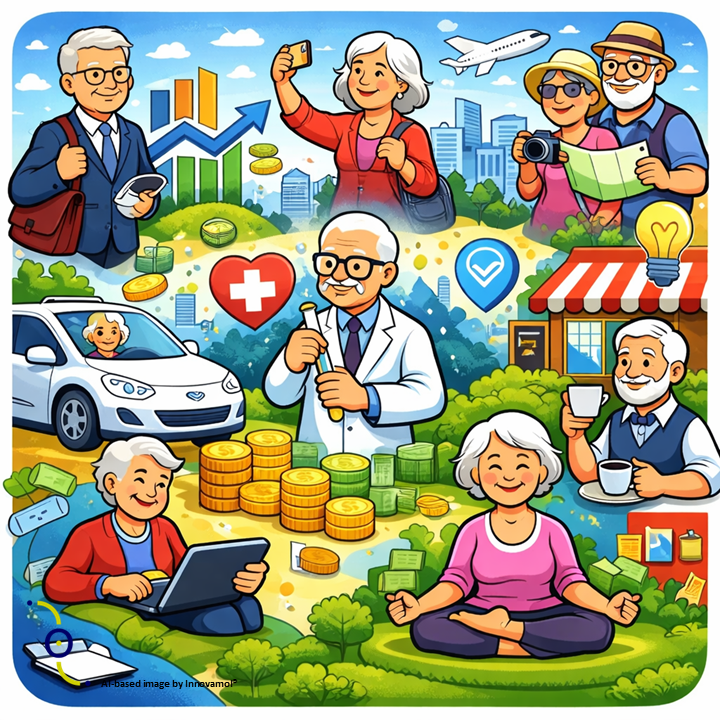
Population ageing is often described almost exclusively in terms of pressure on healthcare systems, pension schemes and public finances. Yet, from another perspective, demographic ageing is also reshaping markets and creating a powerful new economic ecosystem. This is the context in which the concept of the silver economy has emerged.
The silver economy refers to the set of economic activities linked to the needs, preferences and consumption patterns of older adults. Far from being a homogeneous or passive group, people aged 60 and over represent a diverse and increasingly influential segment of society. Many remain professionally active as employees, consultants or entrepreneurs; all are consumers; many are also savers and holders of wealth accumulated over time. Together, they form a complex economic system with significant purchasing power and a growing capacity to shape demand.
This demographic group is already transforming multiple sectors. Healthcare and long-term care remain central, but they are only part of the picture. Housing and urban design, mobility, financial services, leisure, tourism, digital technologies and consumer goods are all being redefined in response to the expectations of older consumers. In the housing sector, for example, there is a growing shift towards age-friendly living solutions: single-level homes, ground-floor apartments and step-free layouts are increasingly preferred, reducing physical barriers and supporting independent living (https://www.mdpi.com/2075-5309/15/22/4148; https://www.mdpi.com/2071-1050/12/3/848). Interior design is also adapting, with furniture becoming more accessible, lower and easier to use, reflecting practical needs without compromising comfort or aesthetics. Similarly, the automotive industry is evolving to better accommodate older drivers and passengers. Car manufacturers are introducing features such as higher seating positions for easier access, improved visibility, more intuitive interfaces and enhanced safety systems. These adaptations not only respond to physical changes associated with ageing, but also contribute to maintaining autonomy and mobility over time. Importantly, these expectations are evolving: today’s seniors tend to be healthier, more educated and more digitally connected than previous generations, and they increasingly seek autonomy, quality of life and personalised solutions rather than purely assistive products.
From a business perspective, the silver economy challenges traditional age-based assumptions. Chronological age alone is no longer a reliable indicator of needs or behaviours. Instead, functional ability, lifestyle, income, health status and personal aspirations play a far greater role. This shift calls for more nuanced market segmentation and for innovation strategies that place real user experience at the centre of product and service design.
The silver economy also intersects directly with labour markets. Older adults are not only consumers, but also contributors to economic activity. Extending working lives through flexible arrangements, lifelong learning and age-inclusive workplace practices can help mitigate skill shortages while preserving valuable expertise. At the same time, entrepreneurship among older individuals is rising, particularly in service-oriented and knowledge-based sectors.
At a systemic level, the development of the silver economy has important implications for sustainability and social cohesion. By fostering active ageing and supporting independence, well-designed products and services can reduce the demand for intensive care and institutionalisation, generating benefits both for individuals and for public systems. In this sense, economic innovation and social impact are closely aligned.
For companies operating in health, life sciences and adjacent fields, the silver economy represents a strategic area for long-term investment. It requires evidence-based approaches, interdisciplinary thinking and a deep understanding of how ageing affects physiology, behaviour and decision-making. Crucially, it also demands a cultural shift: moving away from viewing ageing solely as decline, and towards recognising longevity as a structural feature of modern societies and a driver of innovation.
As demographic trends continue in these directions, the silver economy will not remain a niche. On the contrary, it will increasingly shape mainstream markets, influence research priorities and redefine how value is created across entire industries. For organisations willing to engage with this complexity, ageing societies offer not only challenges to manage, but opportunities to build more inclusive, resilient and forward-looking economic models.
“The best way to predict the future is to create it” – Peter Drucker