
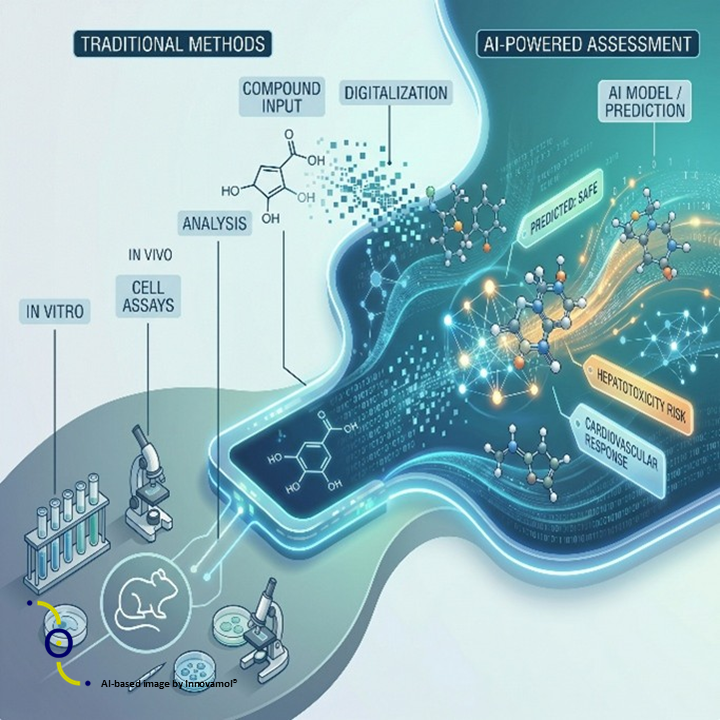
Artificial intelligence is rapidly transforming many fields in science including toxicology, shifting it from a largely experimental discipline towards a predictive, data-driven science. Traditional toxicological assessment has relied heavily on in vitro andin vivo testing, which are often time-consuming, costly, and ethically challenging. In contrast, AI enables and promises the prediction of toxicological outcomes before experimental validation, supporting faster and more efficient safety assessment. This transition aligns closely with the principles of Next Generation Risk Assessment (NGRA), where computational tools play a central role in evaluating chemical hazards (https://doi.org/10.1007/s11356-025-37354-8).
Early efforts in predictive toxicology were dominated by Quantitative Structure-Activity Relationship (QSAR) models, which establish correlations between chemical structure and biological activity. While QSAR laid the groundwork for computational toxicology, it was often limited by its reliance on relatively simple statistical approaches and single endpoints. Recent advances in machine learning and deep learning have significantly expanded these capabilities, allowing for the analysis of complex, non-linear relationships and the prediction of multiple toxicological endpoints simultaneously. These models can now address endpoints such as hepatotoxicity, cardiotoxicity, neurotoxicity, and genotoxicity with increasing accuracy (https://doi.org/10.1371/journal.pone.0282924). However, it is crucial to acknowledge that these data-driven models inherently rely on historical training data. As a result, their predictive power is currently largely confined to already known toxicological mechanisms and established Adverse Outcome Pathways (AOPs). While highly effective at interpolating within recognized patterns, modern AI still faces significant challenges when evaluating substances that operate through entirely novel, undocumented modes of action.
Early computational approaches in toxicology leveraged a variety of algorithms, tools and workflows, including random forests, support vector machines, and artificial neural networks. These methods proved particularly effective at identifying patterns in large and heterogeneous datasets. More recently, AI approaches based on deep learning models have been developed to integrate multiple sources of information, such as chemical descriptors, biological assay data, and omics datasets. This multimodal integration enhances predictive performance and provides a more comprehensive understanding of toxicity mechanisms (https://doi.org/10.1093/bib/bbaf594). At the same time, there is growing interest in explainable artificial intelligence, which seeks to make model predictions more transparent and interpretable. This is especially important in toxicology, where understanding the underlying biological mechanisms is critical for regulatory acceptance (https://doi.org/10.1007/s11356-025-37354-8).
AI-driven predictive models are now widely applied across different areas of toxicology. In pharmaceutical research, they are used to evaluate ADMET properties (absorption, distribution, metabolism, and excretion–toxicity) and identify potential safety issues early in drug development. In environmental toxicology, AI supports the assessment of chemical exposure risks and ecological impacts. Regulatory toxicology is also beginning to incorporate computational approaches, particularly in the context of frameworks such as REACH, where there is a strong incentive to reduce animal testing. High-throughput screening programmes further benefit from AI by enabling the prioritisation of chemicals for experimental testing (https://www.mdpi.com/2039-4713/14/4/101). The advantages of AI in toxicology are substantial. Computational models can process huge numbers of compounds in a fraction of the time required for laboratory testing, significantly reducing costs and accelerating decision-making. They also contribute to the reduction, refinement, and replacement of animal testing, addressing both ethical concerns and regulatory pressures. Furthermore, when combined with biological data, AI can provide insights into mechanisms of toxicity, supporting a more mechanistic and predictive approach to risk assessment (https://www.sciencedirect.com/science/article/pii/S2468111324000409).
Despite these benefits, several challenges remain. The quality and availability of data are critical factors influencing model performance, and inconsistencies or gaps in datasets can lead to unreliable predictions. Many AI models, particularly deep learning systems, still suffer from limited interpretability, making it difficult to fully understand how predictions are generated. The concept of applicability domain also remains important, as models are generally only reliable within the chemical space represented in their training data. In addition, the integration of AI into regulatory frameworks is still evolving, with ongoing efforts to establish guidelines for validation, transparency, and acceptance.
Looking ahead, predictive toxicology is expected to become increasingly integrative and data-driven. Advances in omics technologies, systems biology, and adverse outcome pathways are likely to enhance the biological relevance of AI models. Emerging approaches such as federated learning, which allows models to be trained across multiple decentralized datasets, may facilitate data sharing while preserving confidentiality, and the concept of digital twins could enable more personalised risk assessments. As these developments continue, AI is poised to play a central role in shaping the future of toxicology, supporting safer chemical design and more sustainable regulatory practices.
For Innovamol, these developments are not just relevant; they represent the core of our daily operations. While the broader scientific community often focuses heavily on the final predictive algorithms, a fundamental (and frequently overlooked) aspect of reliable AI is the foundation it is built upon. That is why our expertise heavily involves leveraging AI tools for rigorous data gathering, data cleaning, and data integration. We recognize that meticulous data curation is the absolute bedrock of any reliable model. This data-first approach to AI-driven predictive toxicology supports more efficient screening of novel materials, reduces reliance on experimental testing, and enables the earlier identification of potential risks across the innovation pipeline. By prioritizing high-quality data integration alongside these advanced technologies, we at Innovamol strengthen our capabilities in Next Generation Risk Assessment, contribute to safer-by-design strategies, and deliver robust, data-driven insights that meet both stringent regulatory expectations and market demands.
“Risk comes from not knowing what you’re doing” – Warren Buffett