
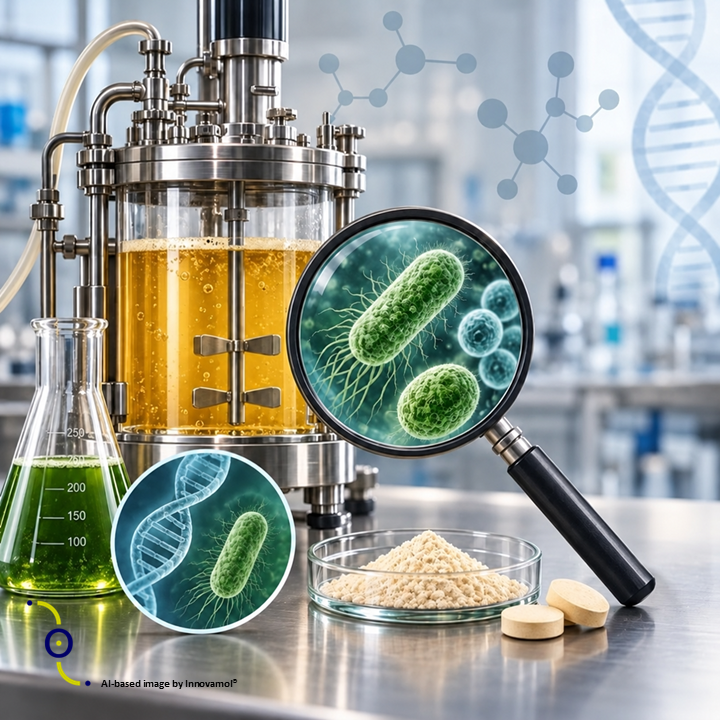
Synthetic biology and precision fermentation are rapidly transforming the way we produce food, chemicals, and materials (Eastham and Leman, 2024; OECD, 2025). Synthetic biology enables increasingly sophisticated and targeted modification or design of biological systems, including the engineering of metabolic pathways and genetic circuits. Precision fermentation uses microorganisms, often genetically engineered, to produce specific compounds such as proteins, enzymes, lipids or other molecules (FAO, 2026). However, genetically engineered microorganisms are not necessarily involved in every process described as precision fermentation, and synthetic biology and precision fermentation should therefore be regarded as overlapping but distinct concepts. Together, these technologies offer opportunities for more sustainable, efficient and scalable production systems. These advantages are potential rather than intrinsic, as performance depends on factors such as feedstocks, energy requirements, production yields, downstream processing and production scale. Yet, as innovation accelerates, regulatory frameworks must continuously adapt to technological developments. Rather than constituting a general regulatory vacuum, the current landscape is characterised by areas of legal uncertainty, regulatory fragmentation and methodological adaptation that could have significant implications for safety, transparency, and public trust (EFSA, 2022; FAO, 2026). At the core of the issue lies the novelty and flexibility of these technologies.
One regulatory challenge concerns differences in how the production process and production strain are considered in the assessment. Regulatory approaches vary across jurisdictions, creating difficulties in harmonising requirements for the characterisation of production strains, genetic modifications, genes or traits of concern, the presence or absence of residual viable cells or production-strain DNA, unintended metabolites and process-related impurities. Within the EU, these aspects are addressed in EFSA’s 2025 guidance for microorganisms used in food and feed production (EFSA,2025), which establishes detailed requirements for microbial identification and characterisation, including whole-genome sequencing, genetic modifications, antimicrobial-resistance and other genes of concern, toxigenicity and pathogenicity, and, where relevant, the presence of viable cells and production-strain DNA. These requirements complement product-specific frameworks, such as EFSA’s guidance for novel foods, which also addresses the production process, composition, specifications, impurities and contaminants (EFSA, 2024), although requirements may differ in other regulatory contexts.
Even within established regulatory systems, boundary and classification questions can emerge. A current EU example concerns products manufactured using genetically modified microorganisms (GMMs) as production strains. In 2025, the European Commission proposed clarifying the circumstances under which fermentation products obtained using GMMs as production strains should not be considered food or feed “produced from GMOs” when the production microorganism has been removed and any remaining residues meet specified conditions. Importantly, this proposed clarification does not remove applicable pre-market safety assessment requirements under sectoral legislation (European Commission, 2025). This illustrates how technological developments and increasingly sensitive analytical methods can expose ambiguities at the boundaries between existing regulatory categories.
Another challenge relates to the pace and scalability of innovation. Synthetic biology platforms can support the rapid development and optimisation of new organism or product variants, including iterative optimisation of production strains and manufacturing processes, whereas regulatory systems generally rely on more time-intensive, case-by-case assessments. This mismatch may increase regulatory uncertainty and assessment workload and create bottlenecks in bringing novel products to market. However, not every modification necessarily requires an entirely new assessment; an important regulatory challenge is therefore to establish proportionate approaches to comparability and change management that distinguish safety-relevant changes from modifications that do not materially alter the characteristics of an authorised product.
Transparency and traceability also present significant challenges. For some precision fermentation products, the purified target molecule may be chemically identical, or highly comparable at the level of the intended target molecule, to its conventionally derived counterpart, although production-system-dependent differences and impurity profiles may still require characterisation. For recombinant proteins in particular, identity of the intended amino-acid sequence does not necessarily imply complete structural or functional equivalence, as the production host and manufacturing process may influence post-translational modifications, protein processing and co-purifying components (Eastham and Leman, 2024).Information about the production process may therefore remain relevant for regulatory assessment, traceability and communication, even when the target molecule is highly comparable to one obtained from a conventional source. Allergenicity provides a related example: where a precision-fermentation product corresponds to a known allergenic protein, alternative production does not in itself imply absence of allergenic risk, and appropriate molecular characterisation remains relevant to the safety assessment (EFSA, 2024). This raises questions regarding labelling, consumer choice and supply-chain integrity. Differences in regulatory and labelling requirements across jurisdictions may result in inconsistent practices and affect confidence among consumers and stakeholders.
Environmental considerations add another layer of complexity. While these technologies are often promoted as sustainable alternatives, their full life cycle impacts are not always well understood. Issues such as resource use, waste streams, and the potential release of engineered organisms into the environment require careful assessment. However, biosafety and broader environmental sustainability should be distinguished. Within the EU, contained use of genetically modified microorganisms is already regulated under Directive 2009/41/EC (European Parliament and Council, 2009), while deliberate release of GMOs into the environment is covered by Directive 2001/18/EC and associated environmental risk-assessment requirements (European Parliament and Council, 2001). The less systematically captured issue may instead be the broader life-cycle performance of the production system, because system-level sustainability considerations are not necessarily the primary object of product-centred food-safety assessments.
At the technological frontier, additional methodological challenges may also arise. EFSA has concluded that existing risk-assessment guidance is generally adequate for most current and foreseeable synthetic-biology applications involving microorganisms, while identifying areas requiring further consideration, particularly unusual or new-to-nature components and more advanced systems such as xenobionts (EFSA, 2022).
Addressing these blind spots will require a more adaptive and integrated regulatory approach. This could include integrating product characterisation with information on the production strain and manufacturing process within proportionate, risk- and exposure-based assessment frameworks, proportionate data requirements and change-management approaches for novel production methods, and fostering greater collaboration between regulatory bodies, industry, and the scientific community. International alignment will also be crucial, as discrepancies between regions can create regulatory divergence, market-access asymmetries, trade friction and complicate global trade.
Ultimately, the challenge is to strike a balance between enabling innovation and ensuring safety and accountability. Synthetic biology and precision fermentation hold considerable promise, but their long term success will depend on the ability of regulatory systems to evolve in step with technological progress. This does not necessarily require entirely new regulatory systems: in many cases, the challenge will be to adapt existing frameworks, clarify regulatory boundaries and develop appropriate assessment tools for genuinely novel biological features. A proactive and transparent approach will be essential to navigate uncertainty, build trust, and realise the full potential of these emerging fields. At Innovamol, our work sits precisely at this interface between scientific evidence and regulatory decision-making: identifying and organising the relevant scientific knowledge, monitoring how regulatory expectations evolve, and transforming complex evidence into structured information that can support the assessment and responsible development of emerging technologies.
“Technology is a useful servant but a dangerous master” – Christian Lous Lange