
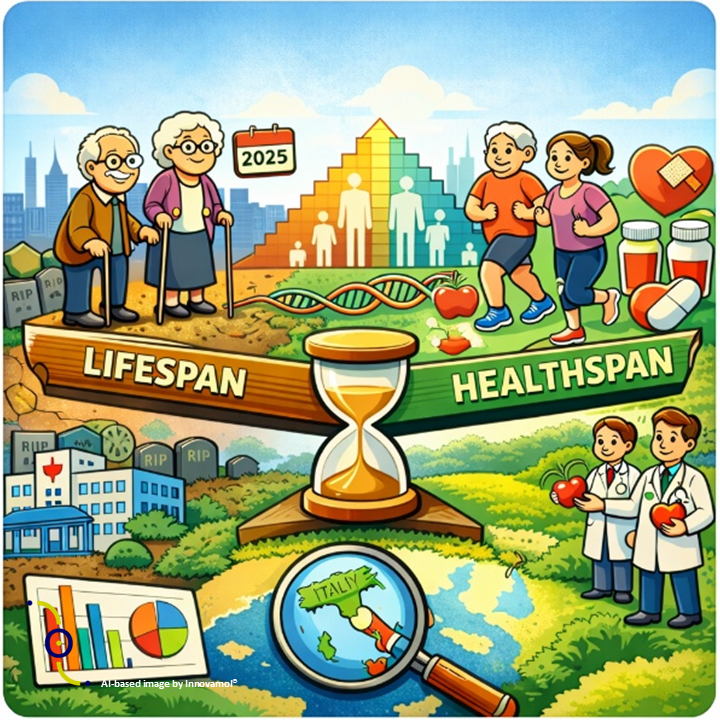
Population ageing will be one of the defining challenges of our future; the goal is not merely to extend lifespan, but to maximize the number of years lived in good health.
For example, Italy is ageing at a particularly rapid rate. According to the latest data from ISTAT (Italian national statistics institute), as of 1 January 2025 the average age of the Italian population reached 46.8 years, while the number of people aged over 65 rose to 14.5 million, accounting for 24.7% of the total population. This demographic shift is driven by two converging trends: declining fertility rates and increasing life expectancy. In 2024, fertility in Italy was estimated at 1.18 children per woman, below the previous historic low of 1.19 recorded in 1995. At the same time, life expectancy at birth reached its highest level ever, rising to 85.5 years for women and 81.4 years for men, with an overall average of 83.4 years, which is almost five months longer than in 2023 (https://www.istat.it/wp-content/uploads/2025/05/RA-2025-volume-integrale.pdf).
The combined effect of longer life expectancy and fewer births is profoundly reshaping the age pyramid. Italy is just an example of this phenomenon, which is particularly evident in all Europe: in 1980, the European Union counted 123 million people under the age of 20 and 53 million aged over 65. By 2020, these two age groups had become almost equal in size, at around 90 million each (https://cpram.com/ita/it/privati/pubblicazioni/megatrends/la-popolazione-mondiale-invecchia).
While lifespan has increased, healthspan, i.e. the number of years lived in good health, has not expanded at the same pace. Living in good health means maintaining autonomy, enjoying a better quality of life and remaining actively engaged in society.
In Italy again, the average number of years lived in good health at birth continues to decline. In 2024, healthy life expectancy for men stood at 59.8 years, returning to 2019 levels. For women, the situation is more concerning: the estimate fell to 56.6 years, the lowest value of the past decade. In just one year, women are estimated to have lost 1.3 years of healthy life expectancy, further widening the already significant gender gap of 3.2 years. In the Italian example, regional disparities remain extremely evident, with Southern Italy recording the lowest healthy life expectancy (55.5 years), compared with the Centre (58.9 years) and the North (59.7 years) (https://www.istat.it/wp-content/uploads/2025/05/RA-2025-volume-integrale.pdf).
Aging is not simply a matter of chronological time; it reflects the extent to which the organism can preserve and coordinate physiological function. Chronological age denotes the number of years lived, whereas biological age (health-based aging) captures the functional state of cells, tissues, and organs, thereby indicating the rate at which the body is aging. Biological age is shaped by the capacity to maintain dynamic homeostasis, the ability to sustain a stable internal milieu despite persistent internal and external stressors. This regulatory balance underpins essential processes including cellular maintenance and repair, metabolic control, and immune competence. When homeostatic capacity is compromised, physiological resilience declines, which can precipitate accelerated aging and increase susceptibility to age-related disease. (https://pubmed.ncbi.nlm.nih.gov/40666427/)
In this context, non-communicable diseases (NCDs) remain to be the main cause of death and disability. These include cardiovascular diseases, cancer, diabetes and chronic respiratory conditions. Ischemic heart disease is the leading cause of death in Italy in 2019 (the coronavirus pandemic “distorted” the numbers after 2019) with 145.24 deaths per 100,000 population (https://www.who.int/data/gho/data/themes/mortality-and-global-health-estimates/ghe-leading-causes-of-death).
Chronic conditions require continuous treatment and long-term care, making their management particularly challenging. Patients often need ongoing medical support, while the costs associated with hospitalisation, healthcare services and pharmaceuticals are substantial. At a global level, chronic diseases are estimated to absorb around 70–80% of total healthcare expenditure. For this reason, the prevention and control of NCDs have become a strategic priority. International efforts have been structured around the World Health Organization’s Global Action Plan for the Prevention and Control of Noncommunicable Diseases 2013–2020, now extended to 2030, which focuses on addressing major risk factors while strengthening national health systems (https://www.epicentro.iss.it/croniche/oms-report-invisible-numbers-2022).
Population ageing is a measurable reality, clearly reflected in demographic and health data. Longevity science examines these data to extend healthspan by investigating the biological mechanisms underlying ageing and adopting a holistic perspective. Together, these approaches provide a solid foundation for understanding how societies are evolving. Interpreting this evidence is essential for anticipating future needs and informing effective action.
Against this backdrop, advancing our understanding of non-communicable diseases and their underlying mechanisms becomes essential to improve healthspan. In this context, Innovamol is actively contributing to research efforts aimed at addressing key challenges associated with ageing and chronic conditions. Past projects, such as investigations into immune-related disorders including celiac disease, as well as research activities linked to oncology through AIRC-funded initiatives, reflect a broader commitment to understanding disease mechanisms at the molecular level. By integrating expertise across different domains, Innovamol is positioned within the wider effort to translate scientific research into tangible impacts on population health and healthy ageing.
“It is health that is real wealth and not pieces of gold and silver” – Mahatma Gandhi