
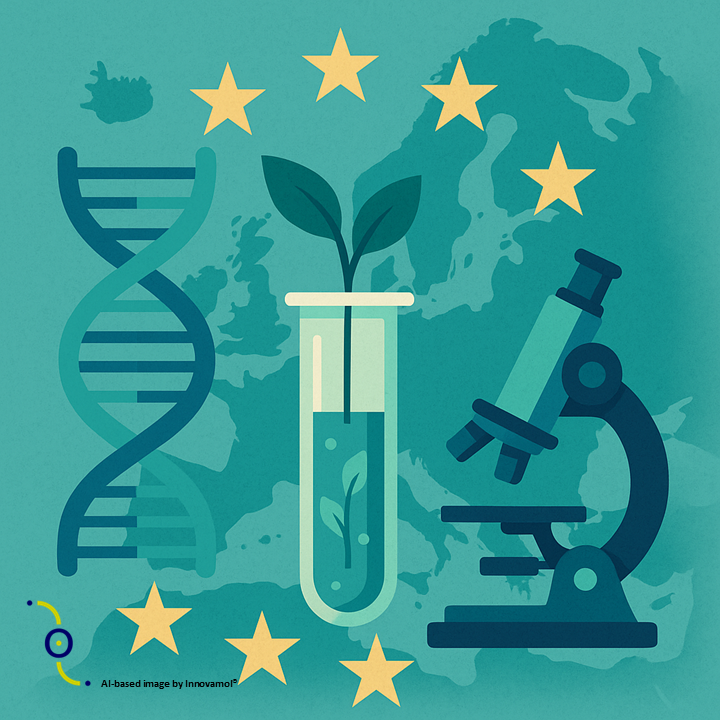
After more than 20 years under an inherently strict GMO regulation, the European Union is updating its rules about biotechnology to catch up with science. Gene editing, synthetic biology, and cultivated meat are no longer just lab ideas, but they are real technologies looking for a path to market. The challenge for Europe is to open the door to innovation while keeping its high standards for food safety and the environment.
In July 2024, European Commission President Ursula von der Leyen announced the launch of a new European Biotech Act, meant to “bring biotech from the laboratory to the factory and then onto the market”. The idea is simple but ambitious: simplify the rules, speed up approvals, and make it easier, in terms of time and costs, for researchers and companies to innovate in Europe rather than move to other countries or continents. It’s part of a bigger plan to build a single market for biotechnology, just as the EU once did for digital technologies.
At the same time, the EU is working on a specific regulation for New Genomic Techniques (NGTs), mainly gene-edited plants. The proposal, published in July 2023, creates two categories. The first category of plants are those whose genetic changes could happen naturally or through traditional breeding, and they’ll be treated like regular crops, with no GMO label needed. The second category of plants, instead, which involve more complex edits or foreign DNA, will still go through full safety checks and labelling requirements. This “two-tier” model is designed to balance flexibility with caution. By 2025, the NGTs regulation was already in its final negotiation phase between the European Parliament and the European Council, while the Biotech Act was open for public consultation across Europe.
All of this means a busy time, especially for the European Food Safety Authority (EFSA), since it is the EU’s main scientific risk assessor for GMOs, novel foods and feed additives, and is now reviewing whether its methods are fit for new kinds of biotech. In recent years, the agency has been updating its guidance to cover synthetic biology and gene editing, running horizon scans and consulting experts. But as applications increase, so will the workload. Some countries, like Denmark, want EFSA to have a faster process for low-risk high-benefit products and more structured pre-application advice for innovators. Others insist that EFSA should maintain strict independence and transparency. For example some NGOs, such as Testbiotech, have voiced concerns about potential conflicts of interest within EFSA’s panels.
Thus, policy around biotechnology in Europe is lively. Germany, France, and Denmark support a broad and cross-sector approach to the Biotech Act, covering everything from agriculture to energy and health. In October 2025, Germany even set “red lines” for the Act, warning against mixing biotech rules with unrelated laws like those on AI or medical devices. Member States are also negotiating the finer details of the NGT Regulation. The European Council’s position allows national opt-outs from cultivating certain crops and requires transparency on patents and databases of gene-edited plants. These compromises reflect Europe’s usual balancing act, which ensure safety and public trust while trying not to slow down innovations.
Meanwhile, stakeholders are pulling in different directions. Industry groups such as EuropaBio say the Biotech Act must be “ambitious and cross-sectoral,” with faster approvals and one-stop regulatory platforms to make Europe globally competitive. They argue that small gene edits shouldn’t be treated like full GMOs, and that Europe risks falling behind if rules remain too heavy. Environmental NGOs and organic associations like IFOAM Organics Europe, on the other hand, want strict labelling, transparency, and exclusion of all gene-edited crops from organic farming. They warn that deregulation could undermine biodiversity and consumer choice. These debates mirror wider tensions in EU food policy, regarding the balance between innovation and precaution, flexibility and control.
Globally, the EU is also feeling the pressure to keep pace. The United States has already approved cultivated chicken meat for sale, and Singapore has regulatory sandboxes that allow safe tastings of novel foods before full authorisation. Canada’s new rules focus on the product rather than the process: if a gene-edited plant doesn’t have new risks, it’s exempt from pre-market checks. China, once cautious, is now approving gene-edited soybeans and wheat as part of its food security push.
Between 2024 and 2026, Europe’s shift in biotechnology regulation could be one of the biggest since the creation of EFSA itself. The NGT Regulation redefines how gene editing fits into EU law, while the Biotech Act aims to create a framework for innovation across all biotech sectors. The goal is not just faster approvals, but smarter regulation that supports competitiveness and sustainability at the same time. Yet success will depend on implementation. Without clear risk criteria, harmonised tools, and open communication, the reforms could stall.
If Europe gets this right, biotech could become a driver of sustainable growth, delivering crops that need fewer pesticides, foods with lower environmental impact, and bio-based solutions for energy and health. If it hesitates, the risk is that innovation happens elsewhere and Europe becomes a follower rather than a leader. The coming years will decide whether the EU’s approach to biotechnology can combine trust, science and progress in a way that works for citizens and innovators alike.
This blogpost was inspired by a work was carried out under a contract with the European Food Safety Authority (EFSA), EFSA/2023/OP/0007 (OC/EFSA/ENREL/2023/01). The opinions expressed are solely those of the contractor and do not represent the official position of EFSA.
If you are interested in these kinds of works or topics, get in touch with us!
“Our future depends on how well we understand this planet and ourselves” – Carl Sagan