
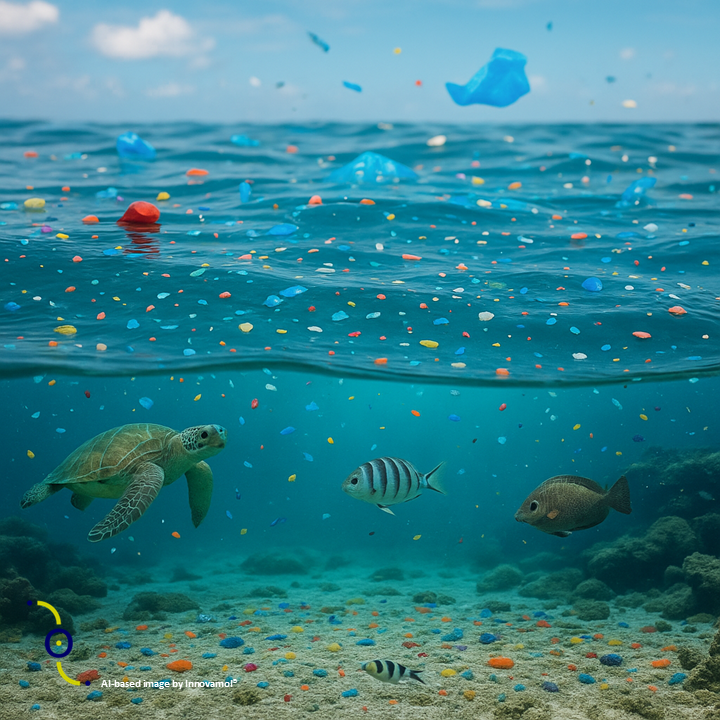
One of the most striking things about micro- and nanoplastics is that they show up in places they were never expected to reach: arctic snow, remote mountain lakes, and the deep sea. Understanding how they get there, and where they go after, is one of the most urgent and complex challenges in environmental science today.
Plastic materials fragment, move, accumulate, and change, in contrast to many pollutants that degrade or settle in predictable ways. Rivers, seas, wind, and even atmospheric currents can carry microplastics, which frequently travel across continents and borders. Their movement and final destination are determined by their size, density, shape, and surface charge, among other physical and chemical properties. Denser particles settle in sediments, whereas lightweight polymers float and follow surface currents. Fibers are especially subject to dispersion in the air.
Nanoplastics add even more complexity to this picture. Their colloidal nature allows them to aggregate with organic matter, pass through biological membranes, and stay suspended in water. They are challenging to monitor and frequently engage in dynamic interactions with their surroundings, forming biofilms or eco-coronas, which change their toxicity and mobility.
Research in glacial environments has shown that even ecosystems once considered pristine are now plastic reservoirs. Snow and ice can trap airborne microplastics from long-range atmospheric transport, which are then released as glaciers melt, potentially accelerating the contamination of freshwater systems downstream. In urban lakes and slow-moving basins, retention time and population density strongly influence plastic accumulation. Indeed, large water bodies with significant human presence become hotspots.
Additionally, soil is becoming a significant microplastic deposit. High concentrations of microplastic particles are frequently found in agricultural fields treated with sewage sludge or composted waste. The behaviour of these plastics in soil is still under investigation, but there is evidence of leaching, vertical transport, and uptake by soil fauna. The interaction of these particles with nutrients, pesticides, or microbes adds another layer of complexity.
Marine dispersion studies show that plastics accumulate preferentially in specific seabed. And, as a consequence, some invertebrates ingest them unintentionally. The plastics themselves may serve as new habitats, which researchers have called the “plastisphere”, hosting microbial communities that further modify their behaviour and ecological impact.
Understanding the fate of plastic particles in the environment isn’t just an academic exercise. Instead, it is essential for risk assessment, waste management improvement, and mitigation strategy design. One thing is certain as researchers struggle for a more comprehensive understanding: micro- and nanoplastics don’t just disappear but they move, change, and accumulate in ways that we are only now starting to understand.
“The environment is where we all meet; where we all have a mutual interest; it is the one thing all of us share” – Lady Bird Johnson