
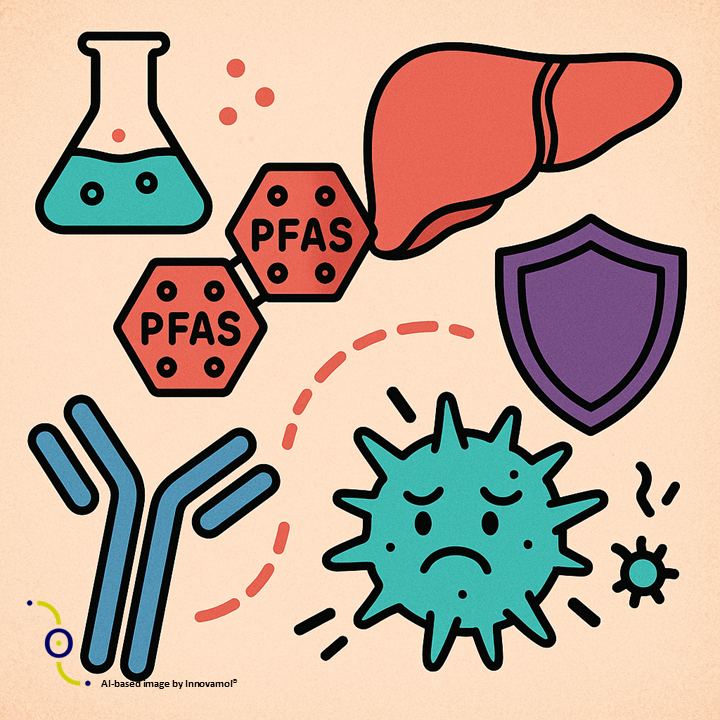
A couple of months ago we wrote about how PFAS research is reshaping the way risk is assessed, drawing on discussions from the BfR meeting in Berlin. On that occasion, we shared insights that emerged from listening to different scientific voices and perspectives. Following this important topic, today we turn our attention to a key question that kept coming back during those discussions: how PFAS interact with the immune system, and what this means for human health beyond simple exposure levels.
Indeed, the understanding of PFAS is entering a more intricate phase, where the focus is shifting from measuring exposure to investigate how these substances interact with biological systems. What once seemed a problem of environmental persistence is now recognised as a question of biological sensitivity. The key insight emerging from recent scientific discussions during the meeting is that PFAS can influence essential immune processes at very low concentrations, revealing vulnerabilities that traditional toxicology overlooked. Rather than causing overt damage to organs, these compounds appear to interfere with the way the immune system learns, remembers, and responds to threats [1, 2].
This perspective reflects a wider change in toxicological thinking, driven by new evidence connecting immune modulation to a range of health effects. Human data linking PFAS exposure to weaker vaccine responses have become particularly influential, showing that the immune system reacts at exposure levels previously considered harmless. Laboratory studies confirm that antibody formation and immune-cell differentiation can be impaired even without visible signs of toxicity. The mechanism seems to involve subtle disruptions of cell communication and energy use rather than direct cell death, suggesting a complex but consistent form of immune dysfunction.
Mechanistic understanding is now shaping how risk is evaluated. The recognition that immune suppression can also play a role in cancer development has strengthened the case for re-examining the long-term implications of PFAS exposure. When the International Agency for Research on Cancer classified PFOA (perfluorooctanoic acid) as carcinogenic to humans and PFOS (perfluorooctane sulfonate) as possibly carcinogenic, it relied heavily on mechanistic coherence across studies rather than simple cause-effect statistics. The integration of biological plausibility into evidence assessment marks a significant methodological shift: risk is increasingly defined by how a substance interacts with key cellular systems rather than by the presence of visible damage alone.
Efforts to establish comparative toxicity scales for PFAS, such as Relative Potency Factors, reflect the need for a more practical way to assess complex mixtures. However, these approaches remain uncertain. When applied to human data, potency adjustments can distort exposure-effect relationships, indicating that the available studies are too inconsistent to support such conversions. For now, grouping PFAS and assessing them collectively remains a safer approach until data from harmonised experiments are available.
Advances in analytical and experimental techniques are beginning to fill some of the remaining gaps. New cell-based and computational models are helping to map how PFAS alter mitochondrial function and cellular metabolism, offering insight into molecular pathways without relying solely on animal testing. These New Approach Methodologies (NAMs) promise faster and more mechanistically informed screening, though regulatory validation remains ongoing for many endpoints (e.g., endocrine disruption [3]). Their growing use signals a broader trend towards predictive and ethically refined toxicology.
Despite these scientific advances, major data limitations persist. Thousands of PFAS exist, yet only a small proportion can be reliably quantified because analytical standards are missing for most compounds. Without reference materials, many substances remain undetectable or only partly identified, creating significant uncertainty in exposure assessment. Addressing this gap will require coordinated international action to establish shared repositories of standards and analytical data, along with acceptance that semi-quantitative results can still guide regulatory priorities.
The direction of PFAS research and policy is becoming increasingly clear. Understanding how these substances influence immune, metabolic, and signalling pathways offers a more realistic view of risk than numerical thresholds alone. The next step is not only to refine detection but to translate mechanistic knowledge into coherent, transparent regulation. Progress will depend on close collaboration between researchers, regulators, and communicators, ensuring that scientific insight leads directly to public protection.
“In nature, nothing exists alone” – Rachel Carson